

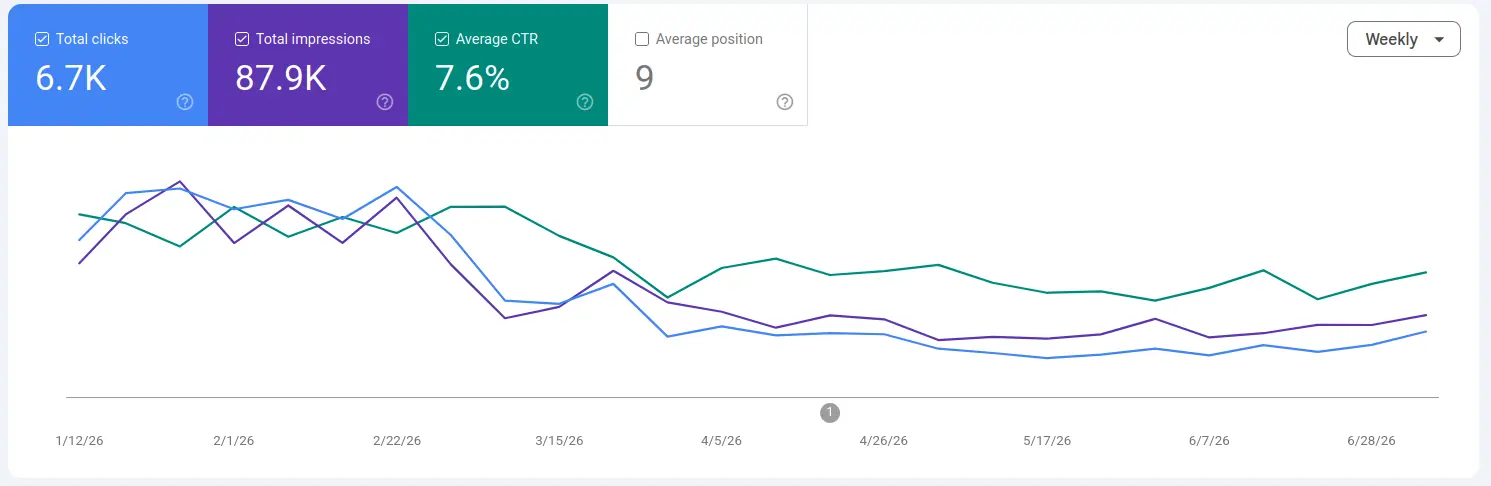
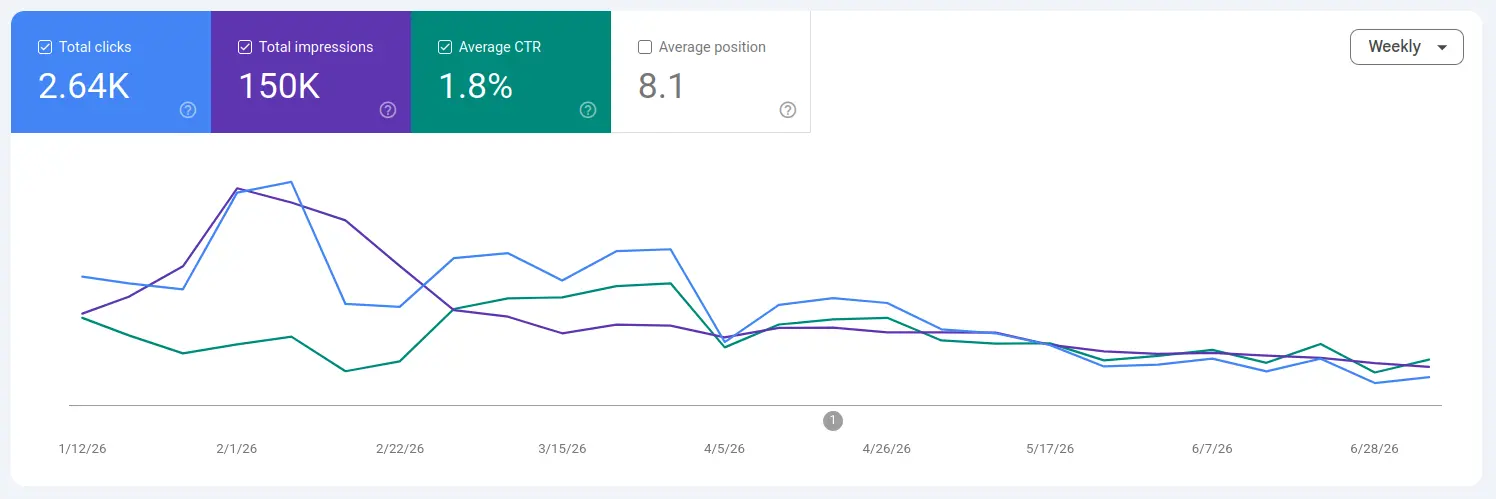
Since late April 2026, organic CTR on two of my projects has dropped by more than half — in sync, to the day, with Google's snippet policy update. Worse: the most obvious "cure", the data-nosnippet attribute, nearly made things worse — it cuts the page out of ChatGPT and Copilot too. Here is what happened and how to take back control of your snippet.
What changed in April
Google updated its snippet documentation. The key quote:
Search result descriptions are created automatically and reflect the content from your page that most closely matches the search query. In other words, users will see different descriptions depending on the words or phrases they used in the query.
The snippet is now assembled on the fly for every query. In practice that often means loosely connected phrases pulled from different parts of the page. E-commerce got hit hardest: product descriptions there are traditionally generated as "product name + CTA", and the algorithm simply has nothing coherent to assemble from.
The data-nosnippet trap
The first idea that comes to mind: if Google butchers your page text, forbid it — wrap the content in <div data-nosnippet>. I almost did. It would have been a worse mistake than the CTR drop itself: since October 2025 Bing honours the attribute too — and Copilot and ChatGPT run on Bing's index. Hide your text from Google snippets and you hide it from the language models at the same time. The cure is worse than the disease: the page vanishes from AI answers entirely.
Is writing meta descriptions even worth it?
Google's John Mueller, answering "Meta descriptions pointless and useless?" on Reddit, put it this way:
Yes, but also, there’s no penalty to writing your own, and sometimes it helps you to figure out a clear focus for a page. Overall, I think it’s still worthwhile to do so for individual pages that you care about, but it’s definitely not a requirement.
Translated from the diplomatic: no guarantees, but per the documentation Google uses your version when it describes the page more accurately than the page's own content. So the job is to write a description that honestly beats the algorithm's cut-up.
Roger Montti's recipe
Roger Montti covered the topic in The Absolute Best Way To Write Meta Descriptions — read the original in full. His algorithm, briefly: identify the one question the page answers; write a short answer; rephrase it as a standalone description outside the question's context; keep it to roughly 120 characters for mobile; add one imperative verb.
My recipe: check GSC first
I agree with Montti on the essentials, but practice shows Google surfaces the same page for queries with entirely different meanings — and builds a different snippet for each. So before writing anything, open Google Search Console: Performance → Pages → pick the page → the Queries tab. That is the full list of real queries Google shows it for.
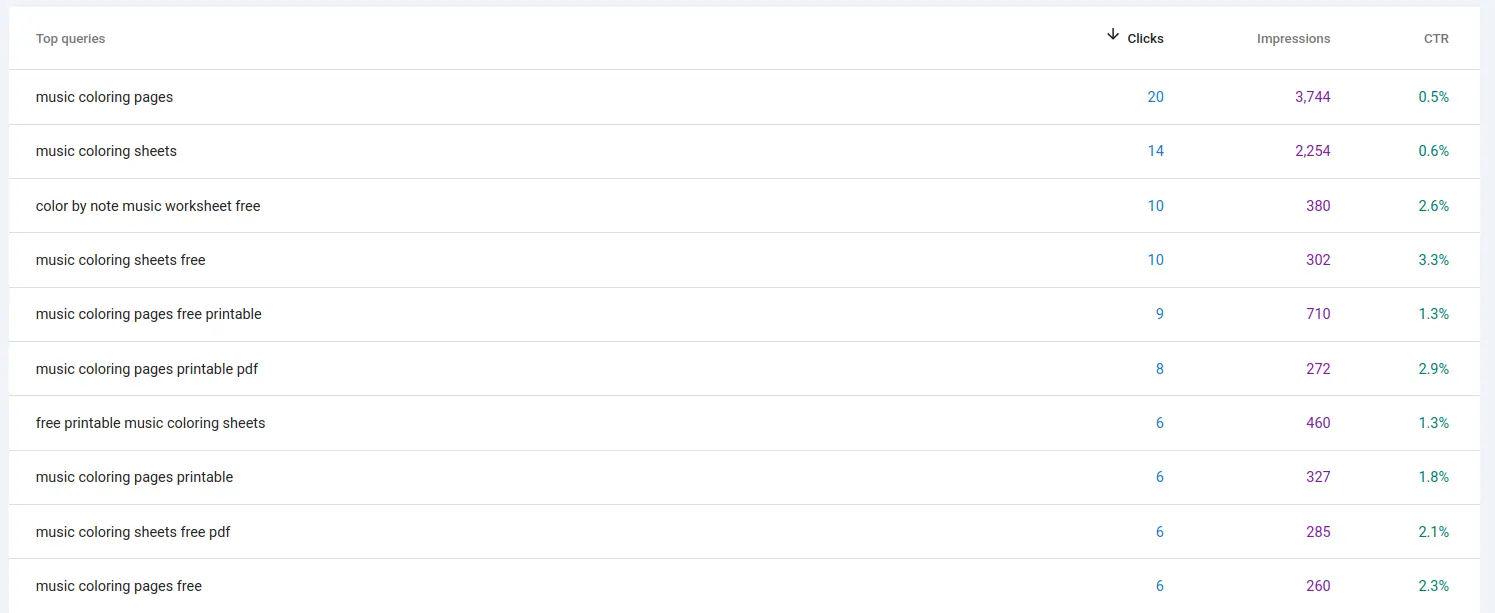
If the queries are few and share one intent — Montti's recipe settles it. If they are all over the place, use my prompt:
1. Analyse [URL] and identify the one question the whole page answers.
2. Write a concise answer to that question.
3. Rephrase the answer as a standalone description of the page, clear outside the question's context.
4. Weave in as many meanings as possible from the real user queries: [queries from GSC].
5. For a commercial page, add the minimum price — "from $12" — only if it is true.
6. Fit the text into 157 characters including spaces, with the whole point readable in the first 120. Use one imperative verb.
Why 157 and 120 at once: 157 is the practical ceiling of a desktop snippet, but mobile truncates around 120 — so the substance must live at the start of the line, with the tail only refining it.
The takeaway: your meta description now has two readers
The first is the snippet algorithm, which uses your version only when it is more accurate than its own cut-up. The second is language models, for which the meta description remains the only self-controlled summary of your page. Hiding content behind data-nosnippet cuts you off from both. Writing descriptions against real GSC queries is the one strategy that works on both fronts.
This article's excerpt was written with this very prompt — check the search results yourself.
P.S. Tested it in practice
On 2026-07-10 I replaced snippets using the technique described in this article on significant commercial pages. Below is the tracking table checked on July 13, 17 and 24: for each page, what Google actually shows in the snippet.
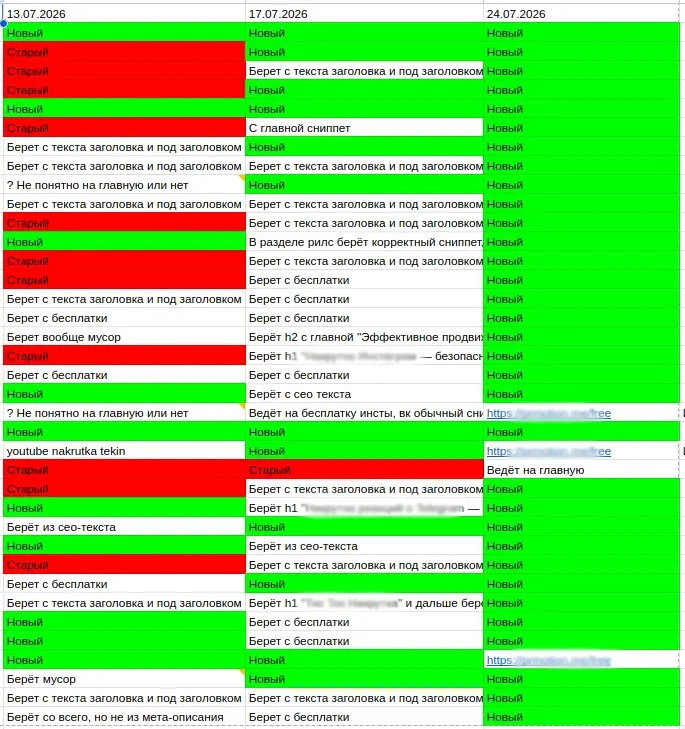
Over two weeks the picture flipped from mostly red ("Old") to almost solid green ("New") — Google picked up the rewritten descriptions on most of the tracked pages. Not without exceptions: a couple of pages are still flagged "unclear whether it leads to the homepage" / "leads to the homepage" where Google pulls the wrong target, and one page's snippet is still assembled "from garbage" — the technique speeds up the switch, it doesn't guarantee it instantly for every URL.

0 comments
No comments yet — be the first to share your thoughts.
Sign in to post your comment instantly:
…or comment as a guest — guest comments appear after moderation.