

A write-up about the recent Google Spam Update is circulating online (and, judging by its style, was likely generated without a fact-check), built around an algorithm called "S-CTS" — supposedly the engine deciding web pages' fate in this update. I checked the primary source. S-CTS is real. It just isn't what that write-up claims. Here's what's actually confirmed, what got mixed up, and what Search Console honestly shows for my own, very young site.
What actually happened
Google finished rolling out the August 2026 spam update — the rollout took 2 days and 16 hours (August 18–21), confirmed by Search Engine Roundtable. It's the third spam update of 2026: March finished in a record 19 hours 30 minutes, June took 2 days 1 hour. Google didn't publish a dedicated blog post or announce any new spam policy categories — meaning the same rules as before still apply.
The "S-CTS" myth: where it came from and what it actually is
The name "S-CTS" (Scalable Cluster Termination System) isn't invented. It's a real Google system, described in the research paper "Scalable Detection of Adversarial Synthetic Slop and Coordinated Media Abuse" (Mathur, Liu, Tan, Liu, Google). The problem is what it's for: the abstract's very first sentence states the target — "online video platforms (OVP)." The system hunts for coordinated clusters of accounts (bots sharing the same generative infrastructure) and bans them as whole clusters, rather than evaluating individual web pages. Independent press reported results specifically on YouTube: roughly 130,000 channels across 50,000 clusters terminated over six months. The paper itself reports engineering metrics — a 32% reduction in cluster validation turnaround time and a 50% reduction in synthetic content review time versus manual moderation, with an overturn rate under 1%.
In other words: someone (or something) took the real name of a real system and assigned it a role it doesn't have — the mechanism of the current web spam update. Neither the paper's authors nor Google's own material on the Spam Update itself makes that connection.
What Google actually calls spam
The official terminology in Google's Search spam policies is far less exotic than an invented system. Two key terms: scaled content abuse — mass-producing pages to manipulate rankings, regardless of what generated them (AI, scraping, synonymizing); and site reputation abuse — hosting low-quality third-party content on an authoritative domain to borrow its ranking signals (Google updated this policy back in November 2024). Both are about a page's purpose and value to the user, not about which tool wrote it.
Context beats the size of the training data
Google's former Chief Scientist Jeff Dean, interviewed by Diana Hu of Y Combinator — covered by Search Engine Journal — described a model's training data as "trillions of tokens stirred together into a soup of hundreds of billions or trillions of parameters." His point wasn't about this spam update or SEO at all — it was about context engineering: clean, purpose-built context for a specific task is more useful to a model than the sheer fact that it was trained on an enormous dataset. The idea still lands squarely on this topic: a page that just restates what a model already "knows" from that soup of tokens adds nothing new for the reader — a page with its own data, specific detail, and verifiable facts does.
What I actually tried to check by hand
Before writing this up, I manually ran the site: operator against 20 WordPress sites from one PBN network, all over a year old, with an average DR around 20. Roughly half of them show up in Google's index. That's not evidence of a drop from the update: for an auto-published network, 50% indexation is normal background noise even with no spam update in play — not every auto-generated article gets indexed on its own merits in the first place. There's no way to tell how much of that 50% is a reaction to this specific update versus just how that kind of network normally behaves. The only site where I saw any signal at all tied to this timeframe was my own.
What's happening on my own site
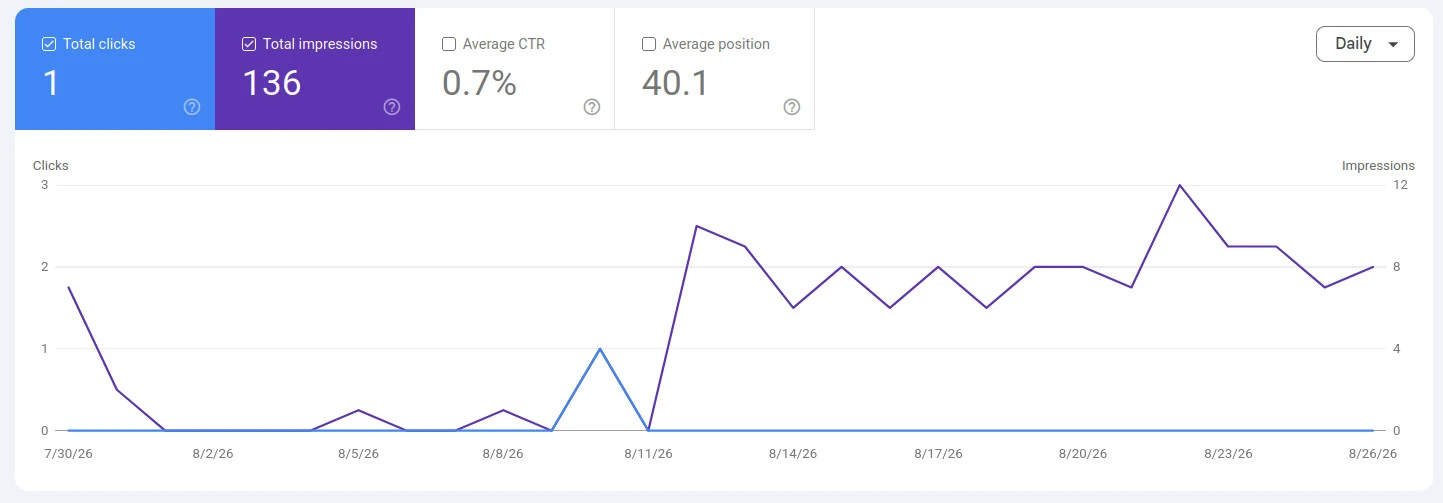
Impressions grew starting around August 11 — but that isn't proof either. The site has only been connected to Search Console for a month, and it's two months old overall: 136 impressions and 1 click mean it hasn't had rankings to lose in the first place. The growth started before the update itself even began (August 18–21), so it looks more like Google indexing fresh pages than any reaction to spam policy. That's the honest answer to "how did the update affect traffic": neither on 20 sites that weren't mine, nor on my own, did I find a signal worth treating as evidence. The dramatic -84%/+38%-style cases that usually get attached to write-ups like this exist somewhere out there — but I won't pass one off as an example when I haven't verified it against my own data.
What to do
- Don't tie your actions to an algorithm that doesn't exist for this purpose. If a piece cites "S-CTS" as the reason web pages dropped, that's a mix-up at best — check the primary source.
- Check Google's actual official terms (scaled content abuse, site reputation abuse) — that's what actually gets visibility reduced.
- If you publish a lot of templated pages, the question isn't "who wrote this" — it's "what's here that nobody else has."
- Don't borrow someone else's drop/growth numbers as an argument for your own strategy — every site has its own age, history, and link profile. Look at your own Search Console data, not market averages.

0 comments
No comments yet — be the first to share your thoughts.
Sign in to post your comment instantly:
…or comment as a guest — guest comments appear after moderation.