

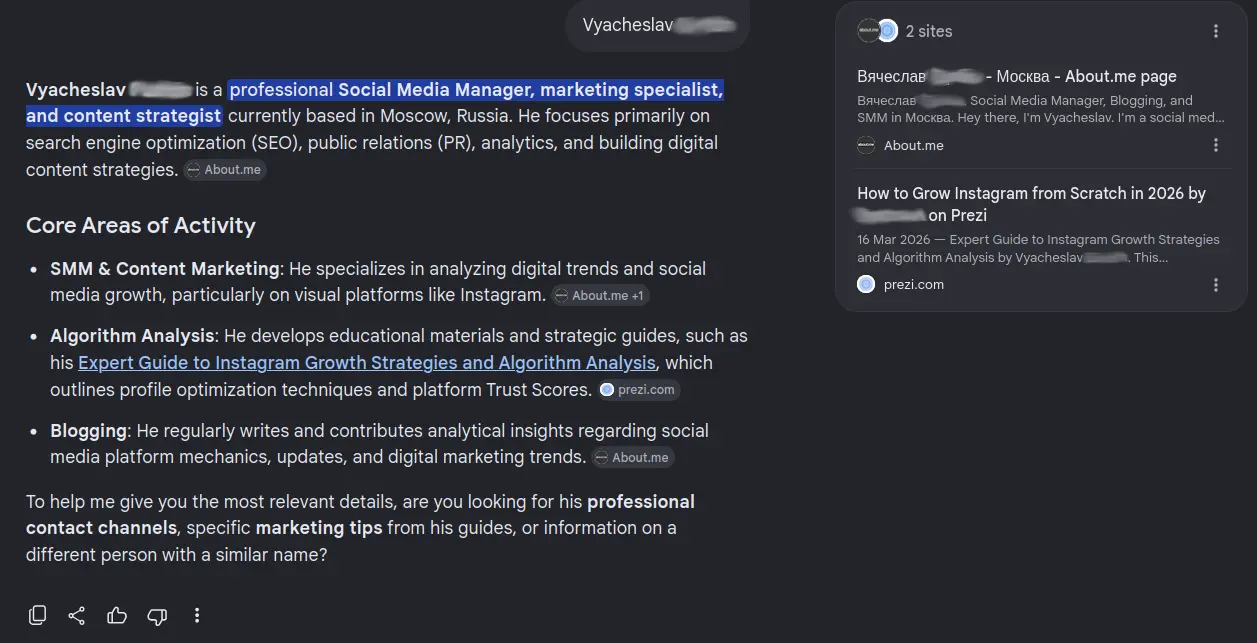
I created an expert who does not exist. He has a name, an author page, profiles and publications — but no passport. Two months in, Google's AI Overviews started answering a query for his name with a detailed profile: who he is and what he specialises in. The algorithm recognised him as a niche specialist. Below is the whole method: why it is legitimate, how it works technically, and the publishing rhythm that made it take exactly two months.
Your business's best expert is you
E-E-A-T rests on expertise, and its primary carrier is not a hired influencer — it is the business owner or a practising employee: nobody knows the processes, the cost of mistakes and the niche's fine print like you do. The problem is elsewhere: Google cannot read minds. If you have never published under your own name, your expertise does not exist for the algorithm. And many people don't want publicity — modesty, NDAs, safety.
A pen name is legitimate. A fake is not
Here is the line worth drawing in bold. Publishing under a pen name is a centuries-old practice — from literary pseudonyms to Nicolas Bourbaki, the "virtual mathematician" under whose name a collective of real scientists published fundamental work for decades. The key condition: real practice stands behind the name. The virtual expert in my experiment is a real practising employee of the company — under a different name.
The opposite case — an invented "expert" with nothing behind him but a text generator — is exactly what Google burns out with its updates against scaled content abuse. One more caveat: do not build virtual experts in YMYL niches (medicine, finance, law) — the cost of error is different there, and the scrutiny is harsher.
Step 1. The expert's digital office on your site
- An author page — a business card on the site: biography, professional track, achievements, certificates. This is the entity's "home" that every other signal will point to.
- Authorship on every article — an active link to the author page from each post.
- Person markup — a schema.org node with name, title, credentials; articles link to it via the
authorproperty ofArticle/BlogPosting. sameAsis the glue. Add every external profile from step 2 and the catalogue below into the Person node'ssameAsarray. This is the thread that stitches scattered mentions into one entity — without it the search engine sees a dozen namesakes. For a live example, inspect this site's markup: the Person here links profiles, credentials and projects.
Step 2. Teaching the LLMs: external authority and Wikidata
AI search — SearchGPT, Perplexity, Gemini — builds answers on entity mentions in sources it trusts. An entity that lives only on its own site is semi-transparent to them. Two moves:
- One name everywhere. Identical spelling, one photo, one wording of the specialisation across all platforms — the algorithm needs something to stitch by.
- Wikidata entities — a Person for the author and, where applicable, one for the project. Wikidata is the reference knowledge graph for most LLMs; an entry there turns "some author" into a verifiable node of the graph. In the anastasiya.studio case this was the step that moved the needle: zero-click mentions and direct citations.
The experiment: two months to recognition
Now the part that matters — a reproducible rhythm. No magic, only regularity:
| Rhythm | Actions |
|---|---|
| Once, at the start | Author page + Person markup with sameAs to all profiles; an About.me card; Wikidata entities |
| Daily (workdays) | One blog article; announcements on X and LinkedIn; a rewrite of the article on Medium |
| Weekly | A Substack issue; a Prezi presentation based on the week's best article |
After two months of this rhythm, a Google AI Overviews query for the virtual expert's first and last name returns a detailed answer: who he is and what his expertise covers. The algorithm officially treats him as a niche specialist.
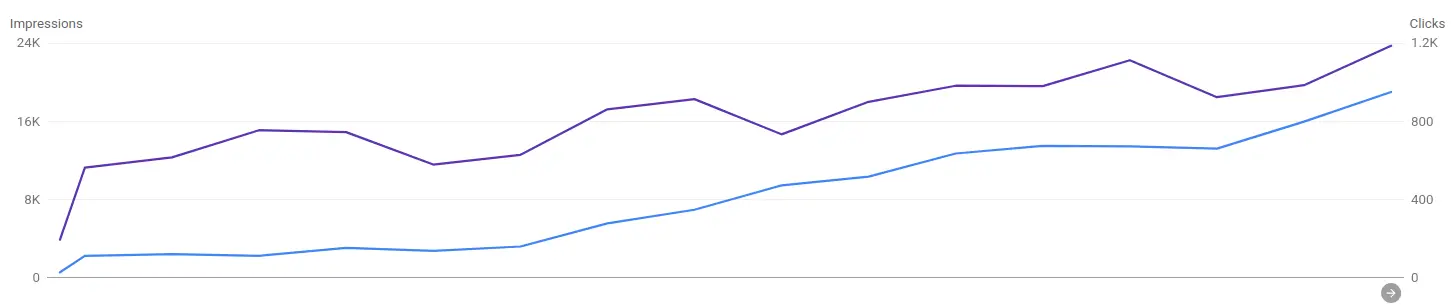
And the consequence the whole thing was built for: before the experiment the site had almost no informational traffic. From the moment the expert was "recognised", articles under his byline entered the rankings — and traffic jumped.
Step 3. The platform catalogue — and what each one is for
Platforms are not interchangeable: each plays a role in the structure. Three platforms with regular publishing beat fourteen with one post each.
| Platform | The signal it provides |
|---|---|
| About.me | The entity's "home" outside your site: a concise card that indexes well |
| Medium | An expert blog on a domain with top-tier authority |
| X (Twitter) | Fast indexing of threads, presence in niche discussions |
| LinkedIn Articles | Long-form in a professional context + a live network |
| Substack | A newsletter with an open archive — regularity as a signal |
| Prezi / Slideshare | Presentations and PDFs — visual knowledge sources LLMs readily ingest |
Today's checklist
- Create an author page and set authorship on every article.
- Ship Person markup and start collecting
sameAs. - Open About.me and profiles on 2–3 catalogue platforms — no more than you can feed regularly.
- Create Wikidata entries: the author and the project.
- Set the rhythm: an article a day on the blog, a rewrite on Medium, announcements on socials, Substack and a presentation weekly.
- A month in, query the name in AI search — and run the free audit: it shows whether AI systems can see your author.
E-E-A-T is built not on bought diplomas but on systematic, machine-readable proof of the author–practice–business link. The experiment shows the algorithms are teachable — and two months of discipline is enough.

0 comments
No comments yet — be the first to share your thoughts.
Sign in to post your comment instantly:
…or comment as a guest — guest comments appear after moderation.