
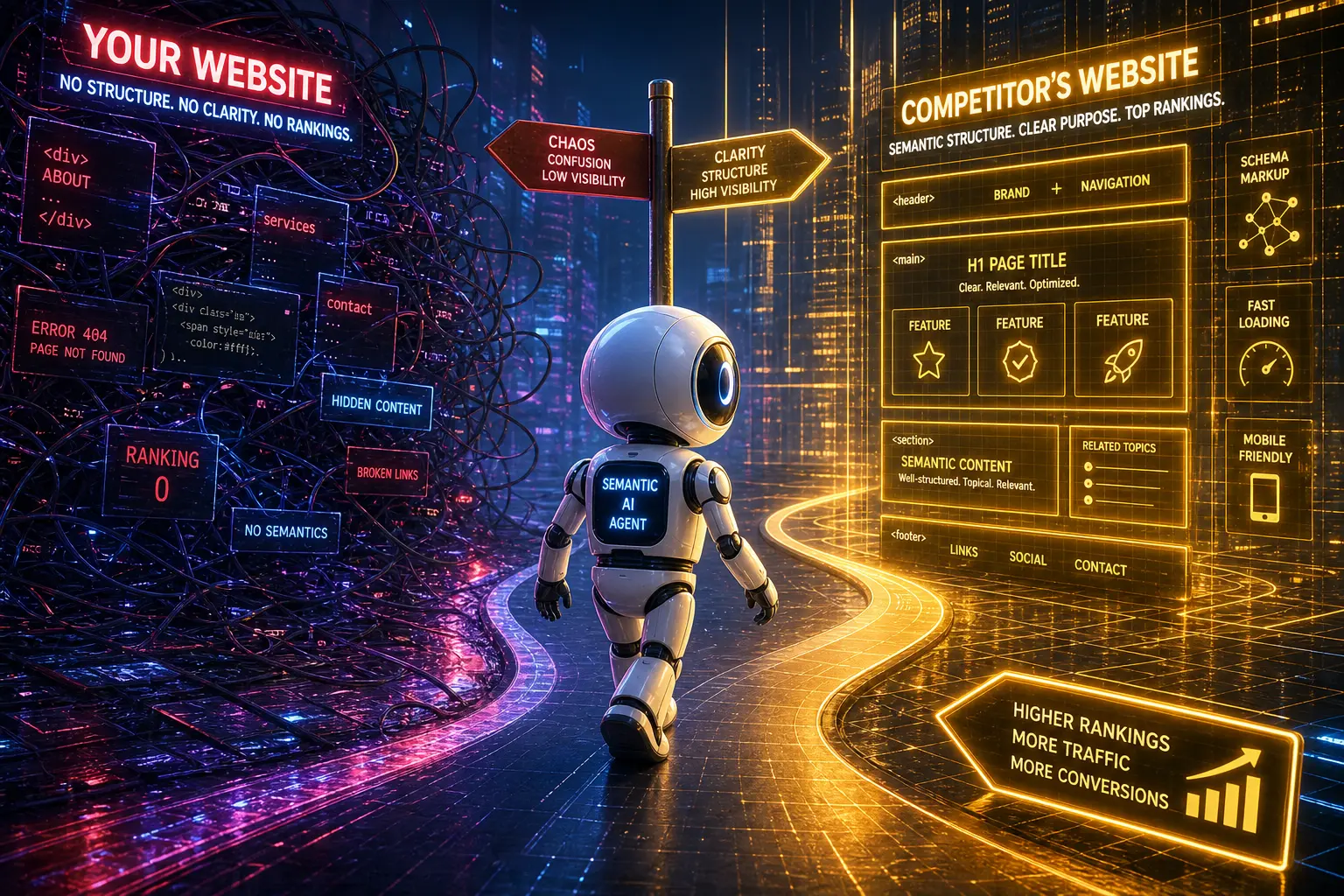
Two independent 2026 studies—intercepting ChatGPT's network traffic and analyzing the "vision" of AI agents—converge on a single conclusion: AI does not quote the best content, but the most machine-readable. Below is what exactly the robot sees on your website and what to fix to get into its answers.
Here is a real recording of ChatGPT's internal monologue, extracted from its network traffic. The model visited a product's official website to check prices—and failed:
"Prices are not displayed directly in the search results, perhaps they are hidden behind JavaScript... I cannot read them. I can use third-party sources... I will use quotes from G2 where appropriate."
The owner of this website spent money on content, design, and SEO. Yet the link in ChatGPT's response—along with the user's trust—went to the G2 aggregator. Not because G2 has better information. But because the robot was able to read it.
This recording was discovered by Suganthan Mohanadasan, co-founder of Keyword Insights and Snippet Digital, in the study "How ChatGPT Actually Picks Sources (I Read the Network Traffic, Not the Outputs)", published on Search Engine Journal in June 2026. Instead of the usual "black box" approach—thousands of prompts and response analysis—he uncovered the process itself: using the Network Panel in Chrome DevTools, he read ChatGPT's JSON traffic and collected about 1,240 records of sources that the model loaded during real search sessions.
The second study came from a different angle. Slobodan "Sani" Manic, a CRO specialist and WordPress core contributor, in the article "How AI Agents See Your Website (And How to Build for Them)" on the No Hacks website, analyzed what kind of "vision" AI agents use—ChatGPT Atlas, Claude Computer Use, Google Project Mariner—when they don't just read a page, but act on it: click, fill out forms, make purchases.
One author looked at how AI chooses whom to quote. The other looked at how AI physically sees the page. The conclusions matched. Let's break them down in order.
Four channels through which ChatGPT accesses your website
According to Mohanadasan, every document that ChatGPT loads into its context is marked with a hidden field result_source. There are four values, and they describe four different worlds:
|
Channel |
What it is |
Who gets in there |
|---|---|---|
|
labrador |
Licensed publisher "whitelist" |
Reuters, WSJ, The Guardian, Wikipedia, arXiv. Snippets of ~1080 characters—effectively full excerpts. You can't get in there without a direct agreement with OpenAI |
|
bright |
Bright Data proxy scraping network |
Commercial queries, e-commerce, finance. Through it, ChatGPT reads Reddit, Forbes, Rtings |
|
oxylabs |
Oxylabs proxy network |
Regional press and the general open web |
|
serp |
Regular web search (likely Bing index) |
Most often news queries |
Practical takeaway: a regular website—yours and mine—competes only in the scraping segment (bright and oxylabs). This means the first condition for visibility in AI is to be easily scrapable: clean HTML, no proxy network blocking, and no critical content hidden behind scripts.
30% of queries do not reach the web at all
Before searching, ChatGPT classifies the user's intent (the turn_use_case field). And if the query is labeled text—web search is not triggered at all: the model answers from its own weights.
Mohanadasan noted that even instructions ("how to change a tire") and medical queries ("latest guidelines for treating type 2 diabetes") were processed without a single internet request in about 30% of cases. Before optimizing a page for an informational query, it is worth checking: does this query initiate a search in principle? If not, there will be no physical traffic from it, no matter how much you invest in content.
One question—up to 40 hidden queries
In "reasoning" models, a single user question unfolds into a fan of 15–40 hidden sub-queries. Ask the AI to compare software prices, and it will start pinpointing the web: queries like site:domain.com/pricing, checking price assumptions, scanning competitors the user didn't even mention.
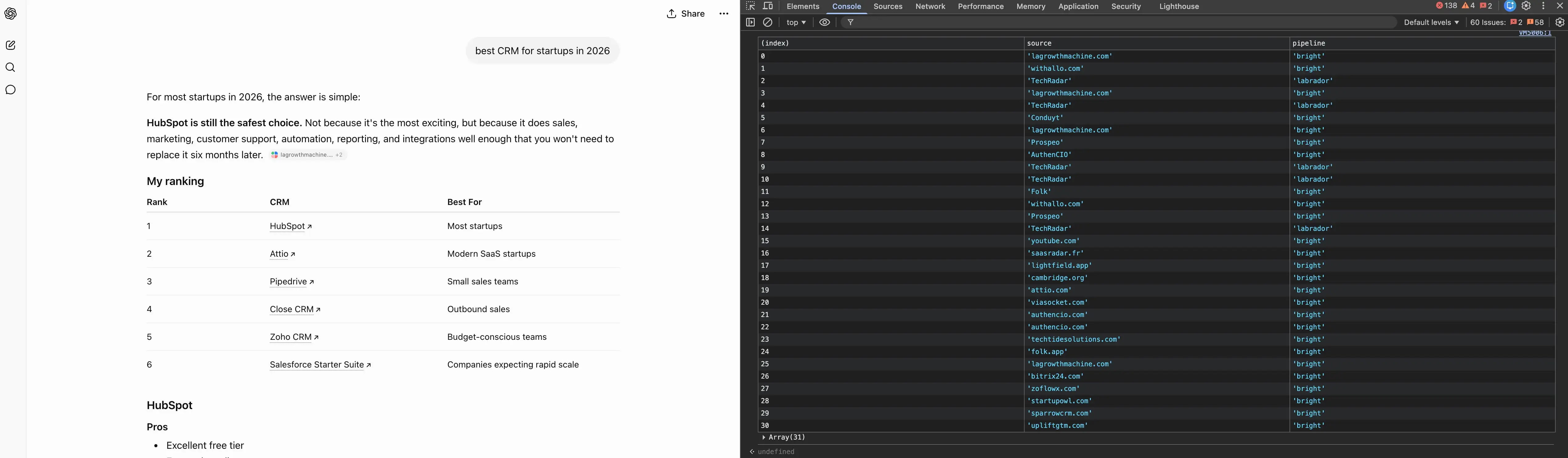
Image Credit: Suganthan Mohanadasan
The parsing mechanics are almost primitive: the model searches the HTML for currency symbols, numbers, and keywords—literally "grepping" the code. If the robot does not find $ and a number next to it in clean HTML, the page is discarded. Prices, rates, and specifications must reside in plain text, rather than being assembled on the fly by a script.
Loaded ≠ Quoted: The Reddit vs. YouTube Case
The most sobering observation of the study is the gap between the three states of a website in the AI's response:
-
Fetched—the page is downloaded into the context (the user does not see this);
-
Cited—the page has become a clickable footnote next to a specific sentence;
-
Mentioned—the brand is named in the text, but the link leads to someone else's website.
In Mohanadasan's sample, Reddit and YouTube were loaded almost equally often: 278 and 201 times. But Reddit received 11 citations, while YouTube received zero. The reason is mechanical: a citation must be tied to a specific text. From Reddit, the robot pulls the entire thread text; from YouTube, only the title and description, but not the video transcript.
Hence, two rules. To get a footnote, being relevant to the topic is not enough—you need to be the best textual proof of a specific fact. And second: ChatGPT deduplicates results by domain, so twenty "watery" articles will collapse into a single entry. One strong page with facts beats a network of weak ones.
A separate detail for local businesses: the variable local_results_limit = 2 was captured in the traffic. For the query "coffee shop nearby," ChatGPT will show two establishments. The fight is not for the top 10—it's for the top 2.
Now the second half of the picture: how an AI agent sees the page
Mohanadasan's study explains whom the AI quotes. Manic's article explains what the AI is actually capable of seeing—and here, the main idea is formulated in a single line:
Optimizing a website for AI agents is 90% the same web accessibility work that specialists have been promoting for decades.
Manic describes three ways agents "look" at a page. Some (Claude Computer Use, Project Mariner) take screenshots and analyze pixels—flexible, but expensive and fragile. Others (ChatGPT Atlas, Playwright MCP) do not see pixels at all: they read the Accessibility Tree—the very structure created for screen readers of visually impaired users. Others combine both approaches.
The consequence is direct: if the "Buy" button is coded as a <div> without the button role, the agent does not understand that it can be clicked. The purchase will not happen—not because of the price or the text, but because of the layout. An AI agent navigates your website in exactly the same way as a blind user with VoiceOver or NVDA.
Manic's recipe is prosaic and therefore convincing:
-
Semantic HTML instead of endless <div>s: <header>, <nav>, <main>, <article>, <button>, <a>—this automatically builds a correct accessibility tree;
-
ARIA attributes (aria-label, aria-expanded)—where HTML is not enough, but they do not fix broken layouts, they complement clean ones;
-
SSR/SSG instead of heavy SPAs: agents can execute JavaScript, but server-side rendering is parsed faster, more stably, and with fewer errors—which directly connects to the G2 story from ChatGPT's logs.
And you can test this without a single AI tool: a screen reader, the Accessibility tab in Chrome DevTools, Lighthouse, Axe. Manic formulates a criterion that is worth hanging on the wall: if you can make a purchase on your website with your eyes closed—from the keyboard, using a speech synthesizer—an AI agent will manage too.
What to do: a checklist based on both studies
According to Manic, the share of non-human traffic on the internet has already exceeded 51%. The robot is no longer a secondary visitor, but half of your audience. Here is what both studies, independently of each other, prescribe to do for it:
-
Expose facts in clean HTML. Prices, rates, specifications—in plain text, without JS rendering. The robot looks for $ and a number; if it doesn't find them, it quotes G2.
-
Check that you are not blocking scrapers. Your channel into ChatGPT is the Bright Data and Oxylabs proxy networks. If you block them, you disappear from the answers.
-
Write fact-proving pages rather than "overview fluff." The citation goes to the best textual proof of a specific statement. One strong page > 20 weak ones (deduplication by domain).
-
Code semantically and test with a screen reader. The accessibility tree is the interface through which an AI agent clicks and buys. A <div> button is invisible to it.
-
Check if your query triggers a web search at all. ~30% of informational queries are answered by ChatGPT from its own memory—optimizing for them is pointless.
-
For local businesses—aim for the top 2, because local_results_limit = 2.
For ten years, accessibility was sold as ethics and caring for a minority of users. As it turned out, it was preparation for an audience that already makes up half of the traffic and decides whom to quote and whom not to. The cheapest SEO of 2026 looks like work for screen readers.
Sources:
-
Suganthan Mohanadasan, "How ChatGPT Actually Picks Sources (I Read the Network Traffic, Not the Outputs)" — Search Engine Journal, June 2026.
-
Slobodan "Sani" Manic, "How AI Agents See Your Website (And How to Build for Them)" — No Hacks, February 2026.

0 comments
No comments yet — be the first to share your thoughts.
Sign in to post your comment instantly:
…or comment as a guest — guest comments appear after moderation.