

The common view is that AI answers have already changed search. I don't think so. Under the hood, search still ranks pages in two stages, and good SEO still leads straight into AI citations. But in 2026 Google took three steps that make it worth preparing for real change: it published the theoretical groundwork for ranking without that pipeline, started paying publishers for their contribution to AI answers, and opened a Search Console report for them.
How search ranks today: two stages
In February 2026, Google DeepMind researchers published "Autoregressive Ranking: Bridging the Gap Between Dual and Cross Encoders." Its introduction is a good short description of how ranking works today. The dominant approach has two stages:
- Dual Encoder (DE) — fast retrieval. The query and documents are turned into vectors, and the nearest candidates are pulled quickly from a huge corpus. Fast, but coarse: the whole relationship between query and document is squeezed into a single similarity score.
- Cross Encoder (CE) — precise reranking. The model reads the query together with each candidate document and assigns an accurate score. That's far too expensive for the whole corpus, so a CE only works on the retrieved candidates.
One caveat: the paper describes standard information retrieval practice, not the internals of Google Search. But the logic of the pipeline is universal. To reach precise reranking, a page first has to make it through coarse retrieval.
That's why good SEO still works for AI answers
The data backs this up. Ahrefs analyzed 1.9 million citations from 1 million AI Overviews:
- 76.1% of cited pages rank in Google's top 10;
- another 9.5% rank at positions 11–100;
- 14.4% don't rank in the results at all;
- the median position is 2 for the first citation, 4 for the second, and 5 for the third.
If you're in the top 10, your odds of being cited are good. But the study has limits: AI Overviews only, only the first three citations per answer, and data from July 2025. The authors themselves say that even from position one, the chance of a citation is "a coin flip at best."
I checked this on a live store
Ahrefs' numbers are market-wide averages, so I checked them against data from anastasiya.studio, a store selling printable music materials that I work with. I took two Search Console exports for the same period, June 15 – September 14, 2026: the new Generative AI report (page impressions in AI Overviews and AI Mode) and the regular performance report (average page position). Then I matched them by URL.
Over those three months the site had 43,983 regular impressions and 6,685 impressions in Google's AI features. 419 pages got impressions in AI.
| Page's average organic position | Pages with AI impressions | Share of all AI impressions |
|---|---|---|
| up to 3 | 79 (18.9%) | 13.8% |
| 3 to 10 | 231 (55.1%) | 78.7% |
| 10 to 20 | 70 (16.7%) | 4.8% |
| 20 to 100 | 39 (9.3%) | 2.6% |
| not in organic results | 0 | 0% |
What the comparison showed:
- 74% of pages with AI impressions rank in the top 10 by average position. Almost exactly Ahrefs' 76.1%. And those pages got 92.6% of all AI impressions.
- Not a single page outside organic results. In Ahrefs' data, 14.4% of citations point to pages that don't rank. Here, every page that appears in AI answers also appears in regular search.
- The top 3 gives no edge over positions 3–10. For every 100 regular impressions, top-3 pages get 15.9 AI impressions and pages at positions 3–10 get 17.2. Beyond the top 10 the share drops sharply: 6.1 at positions 10–20 and 2.8 at positions 20–100.
- AI impressions follow organic ones. Daily impressions correlate at 0.88. On days when the site's average position is better, there are more AI impressions: a correlation of −0.77 with position.
- Into the season, AI grew faster than organic. From August 15 to September 14, regular impressions grew 1.5x over the previous month, while AI impressions grew 2.1x. AI's share rose from 12.7% to 17.9% of regular impressions.
- AI is more visible on mobile: 41.3% of AI impressions versus 21.4% of regular ones. But the site's average mobile position is also better, 4.4 versus 10.6 on desktop. This is most likely a result of rankings, not a separate effect.
Caveats. This is one site in one niche. Google's report counts link impressions, not citations. I compared a page's average position across all its queries, while Ahrefs used the position for a specific query. And correlation doesn't prove cause. But the picture is exactly what a two-stage search should produce: what gets into AI answers is what has already passed retrieval. Which is why, when that retrieval step disappears, the rules will change.
Signal 1. ARR — a theory of ranking without the two stages
The main point of the DeepMind paper isn't the description of today's pipeline but what could replace it. Autoregressive Ranking (ARR) is an approach where a language model doesn't score documents one by one — it generates the identifiers of relevant documents itself, token by token, already in order of relevance. The two stages collapse into a single model, and a separate vector index is no longer needed.
The authors prove two things:
- for a Dual Encoder to produce any ordering of k documents, its embedding dimension has to grow linearly with k. The bigger the corpus, the harder it is for fast retrieval;
- an ARR model with a constant dimension is theoretically able to rank any number of documents.
In the WordNet experiment, ARR performed on par with a Cross Encoder and clearly outperformed a Dual Encoder. And the authors' proposed loss function, SToICaL, cut the rate at which the model scored an irrelevant document above a relevant one from 27.66% to 0%.
It's important not to overstate this. It's a theoretical paper, the experiments are small (WordNet and the ESCI shopping queries dataset, on Mistral-7B), and nobody claims Google Search already works this way. But the direction is clear, and there is now a theoretical foundation for it.
What this means for SEO — this part is my conclusion, not the authors' claim. In a two-stage pipeline there's a step where a page is found by its similarity to the query, and classic SEO gets you there. In ARR, the model names the documents it considers relevant on its own, and there is no separate "make the candidate set" step. So the weight shifts from how closely a page matches the query to how well the model knows you, your site, and your content.
Signal 2. Google has started paying for contributions to AI answers
On September 14, 2026, Digiday reported the launch of the AI contribution pilot. Google pays publishers not for every mention but when their content "significantly" contributes to answers in Gemini, AI Overviews, and AI Mode. The amount shows up in an AI earnings widget in Search Console. Google itself describes the program as testing a new model for working with websites "whose content helps keep its generative AI answers fresh and accurate."
There's plenty of criticism: publishers call the payouts "peanuts" and the calculation a "black box," and skeptics see the program as a hedge against regulators. But the fact itself says a lot. Google has acknowledged that content has value as raw material for AI answers, not just as a page in the results, and has started building an economy around it.
Signal 3. An AI report is already in Search Console
Search Console now has a Generative AI performance report. It shows how many times links to your site were shown in AI Overviews and AI Mode, broken down by page, country, date, and device. According to Google, the report has been available to all sites since August 31, 2026. It will be empty if your site doesn't get enough impressions in AI features, and it doesn't include Search Labs experiments.
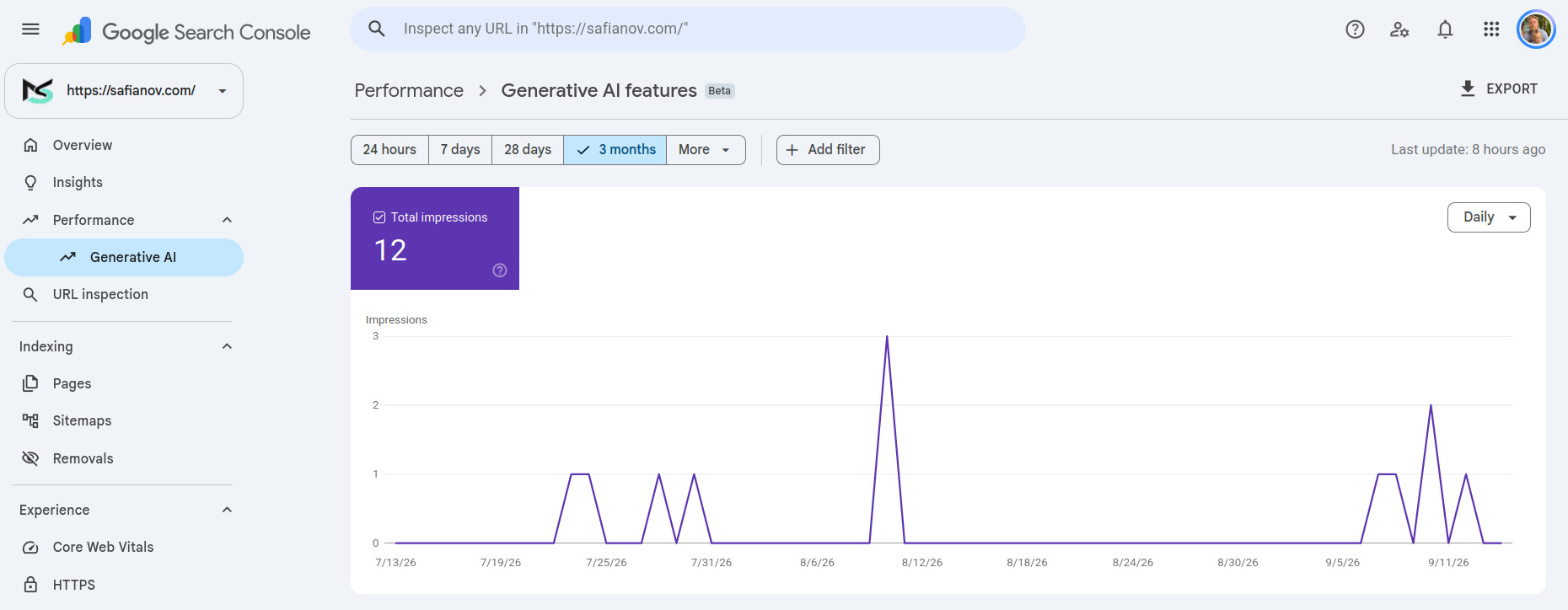
My own numbers are modest: 12 impressions, with the biggest spike at 3 in a single day. The site is two months old, so this isn't a result but a baseline, which I cover in point 7 below. The beta's limit is already visible too: the report shows only impressions, with no clicks, CTR, or position.
A separate report means a separate channel with its own metrics. Google has split AI impressions from regular ones, and now they can be measured.
What to do right now
This blog's tagline is "indexing the future of search." Here's what I recommend preparing for while the top 10 still leads to citations.
1. Content: every article needs a "nugget"
A nugget is something competitors don't have: your own data, an experiment, a screenshot, a conclusion that can't be rewritten from someone else's site. A model that generates the answer itself has no use for the hundredth rehash of the same thing. Content farms are already ineffective and will soon be dead for good.
2. Expertise: stop being modest
If the model is going to pick the people it knows, it needs to know you. It's time to put yourself on as many authoritative platforms as you can: about.me, Medium, industry directories, Wikidata. Be careful with Wikidata: it has notability rules, and items created for self-promotion get deleted. Create one once independent sources are already writing about you. I showed how this works in practice in the article about building an E-E-A-T expert.
3. Networking
Active participation in professional communities may not bring you leads. But mentions in discussions, forum answers, joint pieces, and talks build your authority in the eyes of AI. Models learn from what other people write about you.
4. Don't abandon classic SEO
As long as the pipeline has two stages, 76% of citations come from the top 10 according to Ahrefs, and on anastasiya.studio top-10 pages collected 92.6% of AI impressions. Indexing, speed, internal linking, and rankings remain your ticket into AI answers. Preparing for the future at the expense of the present is a bad strategy.
5. Become an unambiguous entity
If the model has to recall you on its own, it needs to know exactly who you are. The same name, job title, and brand name everywhere. Person and Organization markup with sameAs links to all your profiles. The same spelling of your name on every platform. Scattered profiles under different versions of your name may never get connected into one person.
6. Make your content machine-readable
Prices, specs, and key facts belong in the HTML, not hidden behind JavaScript. AI cites what it can read. There's a detailed breakdown with data in the ChatGPT article.
7. Take a baseline in the new GSC report
Open the Generative AI report now and note which pages get impressions in AI Overviews and AI Mode. Compare it with the regular performance report. Pages that show up in AI but are weak in organic search, and the other way around, will tell you what the model values on your site. When the rules change, you'll have something to compare against.
8. Update your key pages and show dates
In describing its pilot, Google talks about content that keeps answers "fresh and accurate." A publish date and an updated date on the page, current numbers, and change notes are a cheap way to show freshness to both people and models.
Search hasn't changed yet. But Google has already written the theory, opened the cash register, and installed the meter. Better that when the rules change, the model already knows you by name.

0 comments
No comments yet — be the first to share your thoughts.
Sign in to post your comment instantly:
…or comment as a guest — guest comments appear after moderation.